

Let me ask you something real.
Last week, you probably completed at least a handful of jobs. Maybe you wrapped up an HVAC installation in Irvine, finished a landscaping project in Anaheim, knocked out a bathroom renovation in Costa Mesa. You invoiced the customer, they paid, and you moved on to the next one.
But here’s my question: Do you actually know if you made money on those jobs? Not “did money come in” — I know money came in. I mean: after your labor, your materials, your drive time, your equipment, the wear on your truck, the texts you answered at 9pm to keep that client happy — did you actually profit?
Most service business owners I sit down with in Orange County can’t answer that question. And it’s not because they’re bad at business. It’s because nobody ever showed them how to look at it correctly.

The Story of Two Contractors
I want to tell you about two guys. I’ll call them Miguel and Tony. Both run landscaping crews in central Orange County. Both gross roughly $300,000 a year. On paper, they look identical.
Miguel takes every job that calls. He stays busy. He’ll quote $800 for a cleanup job, dispatch a two-man crew for a full day, and call it a win. He’s always got money in the account when payroll hits, so he assumes he’s fine.
Tony does something different. Tony tracks every job. Before he sends a crew, he runs a quick number — what will this job actually cost me? Then he decides whether to bid, and at what price.
At the end of the year, Miguel is exhausted, behind on his truck payment, and confused about where the money went. Tony works fewer jobs, stresses less, and took his family to Cancún in October.
Same revenue. Completely different lives. The difference? Tony knows his numbers at the job level. Miguel only knows his total sales.
What “Job Profitability” Actually Means
Job profitability — or what accountants call a job costing analysis — is pretty simple in concept. For each job you complete, you ask three questions:
- What did I charge? (your invoice total)
- What did this job actually cost me? (materials + labor + overhead allocated to this job)
- What’s left? (your gross profit on that specific job)
That leftover number — that’s your job margin. And when you track it consistently, patterns start to emerge that can change how you run your business.
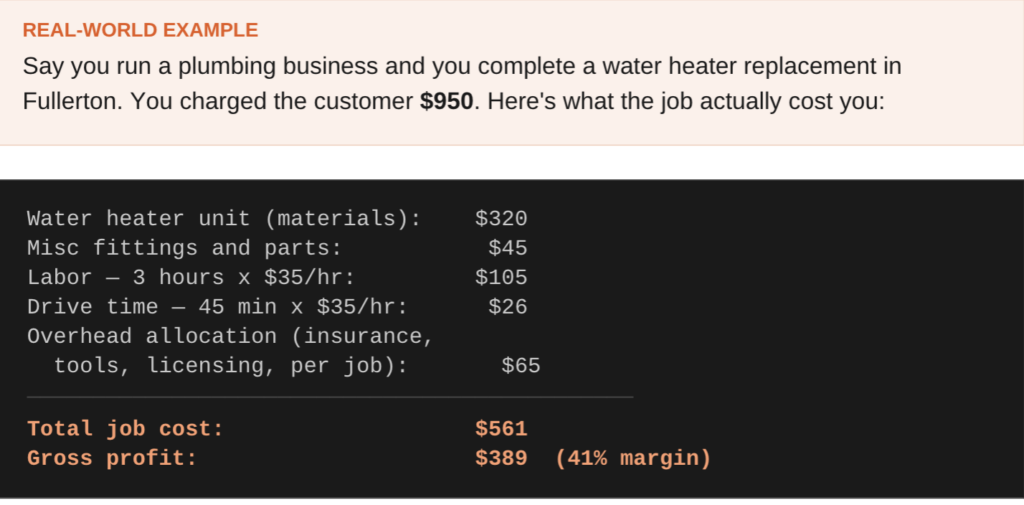
Forty-one percent. Not bad. But now imagine you quoted that same job at $750 because a competitor was going lower and you wanted the work. Same costs. Same labor. Suddenly your margin is 25% — and on a busy week of ten jobs like that, you just gave away nearly $1,400 in profit without realizing it.
That’s what I call accidental discounting. And it’s one of the most common silent killers of service business profitability.
The Hidden Costs That Eat Your Profit
Here’s where most contractors and service business owners lose the game: they only think about materials and direct labor. They forget — or don’t know how to account for — everything else.
Drive time and fuel
If your tech drives 45 minutes each way to a job, that’s 90 minutes of paid time that produced zero billable output. Are you building that into your pricing? Most aren’t.
Callbacks and warranty work
A job you quoted at $1,200 might look great on paper. But if you had to go back two weeks later for a callback (for free), add that labor cost back into the original job. That margin you thought was 35% might actually be 15%.
Materials waste and over-ordering
Leftover materials from one job usually end up on the truck or in the shop, not accounted for. Over time, that waste quietly adds up against your margins.
Your own time, if you’re working the jobs
This is the one that gets owner-operators the most. If you’re swinging the hammer or running the crew yourself, you have to assign a dollar value to your time — otherwise you’re not counting a real cost. Your labor is not free just because it doesn’t hit payroll.

Why This Matters Beyond the Math
Once you start tracking job profitability, something shifts. You stop taking jobs out of desperation and start taking them strategically. You realize that the $2,000 commercial account you’re working every month is actually making you $180 in profit, while the $800 residential job you almost passed on is netting $320.
You also start to see which types of jobs are more profitable — and that insight is gold. Maybe your electrical installs have great margins but your service calls are barely breaking even. Maybe your commercial clients pay slower and cost more in overhead. That’s information that changes how you market, how you quote, and how you grow.
This is the kind of financial clarity that separates business owners who feel stuck from business owners who feel in control. And I’ve sat across the table from both.
The Fix: A Simple Framework to Start Today
You don’t need complicated software to start doing this. You need three things: consistency, a simple template, and someone to help you read what the numbers are telling you.
- Track every job, not just the big ones. Job costing is most valuable when it’s comprehensive. A pattern you can’t see in one job becomes clear across twenty.
- Assign a labor rate, including yourself. If you pay employees $28/hr, that’s your labor cost. If you work the job yourself, decide what your time is worth — and use that number.
- Add overhead allocation. Total up your monthly fixed costs (insurance, licensing, truck payments, shop rent, software) and divide by the number of jobs you average per month. That’s your overhead per job.
- Compare actuals vs. your quote. After every job, compare what you thought it would cost to what it actually cost. That gap is your feedback loop.
- Review monthly, not just tax time. The whole point of this is to make decisions in real time — not find out in April what went wrong in August.
The Bottom Line
Mira — I’m not trying to scare you. I’m trying to give you an edge. Most of your competitors are flying blind. They look at their bank account on a Friday afternoon and guess whether things are going okay. You don’t have to do that.
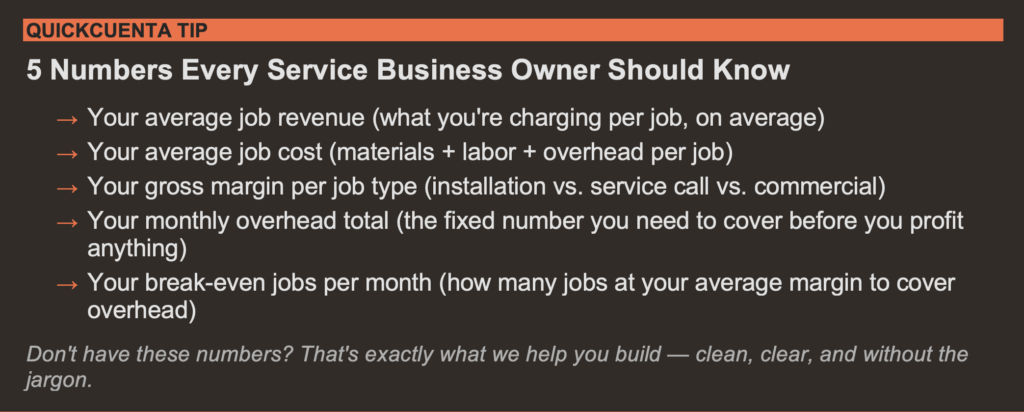
Job profitability tracking is one of the first things I build with every new QuickCuenta client, because once you can see which jobs are making you money and which ones are just keeping you busy — everything changes. Your confidence changes. Your quotes change. Your growth strategy changes.
You worked too hard to build this business to leave money on the table on every other job. Let’s fix that.
Frequently Asked Questions
Q1: What’s the difference between revenue and job profitability?
Revenue is the total amount a client pays you for a job. Job profitability is what’s left after you subtract your labor, materials, subcontractors, and overhead. A job can look great on your invoice and still lose money. Knowing the difference is the first step to making smarter pricing and hiring decisions.
Q2: Why do service businesses struggle with job costing?
Most trade and service businesses track what comes in — not what it actually cost to complete each job. Labor hours get underestimated, material waste gets ignored, and overhead rarely gets allocated properly. Without a simple system to track job costs, you’re essentially guessing whether you made money.
Q3: Do I need accounting software to track job profitability?
Not necessarily. You can start with a simple spreadsheet that tracks revenue, labor, and materials per job. However, as your business grows, tools like QuickBooks or Jobber make this much easier and more accurate. What matters most is building the habit — the software just automates it.
Q4: How do I know if my prices are too low?
If you’re consistently busy but cash flow feels tight, your prices are probably too low — or your costs are higher than you think. Start by calculating your true cost per job (labor + materials + overhead). If your price doesn’t leave at least a 20-30% margin after those costs, it’s time to reprice.
Q5: Can a bookkeeper help me improve job profitability?
Yes — a bookkeeper who understands service businesses can set up a job costing system, categorize your expenses correctly, and give you monthly reports that show which jobs and clients are actually making you money. At QuickCuenta, we specialize in exactly this for HVAC, plumbing, landscaping, and other trade businesses in Orange County.
Q6: Where do I start if I’ve never tracked job costs before?
Pick your last 5 completed jobs. For each one, add up what you paid in labor, materials, and any subs. Compare that to what the client paid you. That simple exercise will tell you a lot. From there, build the habit of doing it for every job going forward — even if it’s just a notepad or spreadsheet to start.
Not sure where your numbers stand? Book a Free 30-Min Financial Clarity Call at quickcuenta.com